
Recently, when I wrote about bio-hydrogen produced from biomass (https://shorturl.at/tYvhx), I was mainly considering biomass gasification and converting the resulting syngas (CO + H2) to H2, or recovering H2 from biogas.
Some days back, I got a note from Mridula Ramesh, a prominent climate tech investor and acclaimed author on water sustainability, about a paper her son had written on bio-hydrogen from wastewater, using microbial pathways. I spent some time reviewing this over the weekend.
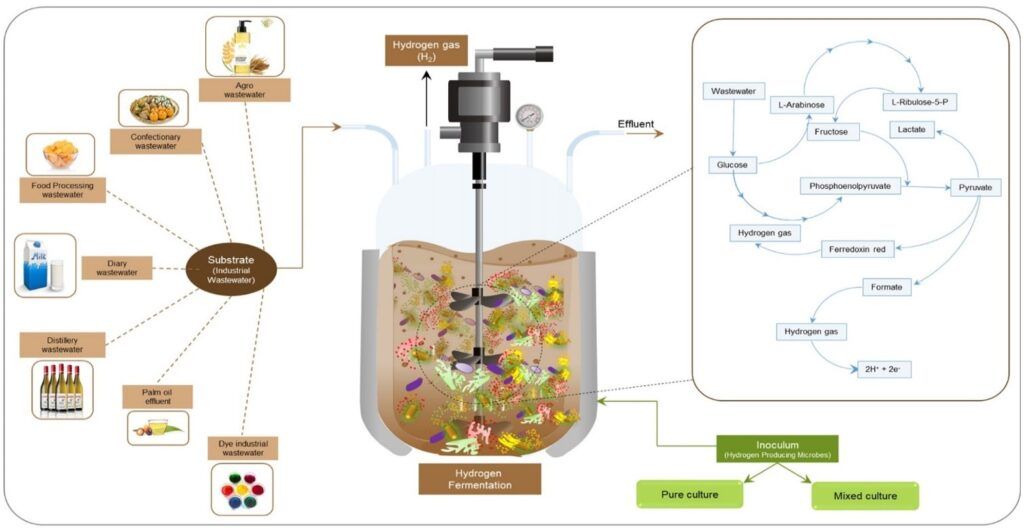
Based on the paper, microbial H2 production from wastewater works something like this:
𝐏𝐚𝐭𝐡𝐰𝐚𝐲 1: 𝐋𝐢𝐠𝐡𝐭-𝐝𝐫𝐢𝐯𝐞𝐧: Microorganisms - instead of electricity - split water into H2 and O2 using direct sunlight as the energy source. A variation of light induced hydrogen production is when microorganisms use sunlight and CO2 to produce intermediary organic chemicals which then gives out H2. Neither of these two requires any organic substrate in water, which also implies this does not need waste water, just fresh water would do.
𝐏𝐚𝐭𝐡𝐰𝐚𝐲 2: 𝐅𝐞𝐫𝐦𝐞𝐧𝐭𝐚𝐭𝐢𝐨𝐧-𝐝𝐫𝐢𝐯𝐞𝐧: Microorganisms act on organic substrate in water - sugars such as glucose, acetic acid etc - and release hydrogen; such substrates are available in a range of domestic and industrial waste-water discharges.
Well, the above is the summary; those interested can read the detailed paper - https://lnkd.in/gY2vFr37
In my opinion, any idea that recovers value from wastewater is worth exploring - more for the environmental mitigation that it provides and less from the actual value recovered.
In this case too, I have my doubts about the scalability of microbial processes to produce hydrogen from wastewater. Microbes are funny critters; difficult to maintain their activities at optimal conditions, resulting in non-scalable and expensive processes. Even a rather simple application of microbial biofuel - biogas - is still finding its feet when it comes to scale, even though biogas has been there for long (Trivia: The world's very first biogas plant was started in 1859 in a leper colony in Mumbai).
But if you consider microbial processes to remediate wastewater and produce something in the process - as microalgae already do in some places around the world - it presents a more viable business case. A business case that many industries that generate organic-rich wastewater could be interested in.
Good learning during an otherwise mediocre weekend.
As an aside, I was curious about the author of this detailed research paper; as nothing could be found about her son online, I asked Mridula if he was doing a Masters or something. To my surprise, she said he was in his 11th grade.
If high school students are publishing such papers on important topics, perhaps I should complain less about the much-maligned ( by me) gen-zs.
(See all my decarbonization posts from 𝐍𝐞𝐭 𝐙𝐞𝐫𝐨 𝐛𝐲 𝐍𝐚𝐫𝐬𝐢 - https://shorturl.at/jx137 )
