
"𝘛𝘢𝘵𝘢 𝘚𝘵𝘦𝘦𝘭 𝘢𝘤𝘩𝘪𝘦𝘷𝘦𝘴 𝘉24 𝘣𝘪𝘰𝘧𝘶𝘦𝘭 𝘷𝘰𝘺𝘢𝘨𝘦 𝘧𝘳𝘰𝘮 𝘈𝘶𝘴𝘵𝘳𝘢𝘭𝘪𝘢 𝘵𝘰 𝘐𝘯𝘥𝘪𝘢" - blared the headlines of a recent news item. ( https://lnkd.in/dZQQ4yZt )
Sounds like a rather important development. I think it indeed is, but it is also important to understand how important it is, and for which sector!
Here is why I'm spinning words around this news item:
=> We are not talking about Tata Steel using biofuels at its refinery.
=> We are not even talking about Tata Steel using biofuels to reduce the emissions of steel or iron ore being shipped in or out.
𝐖𝐞 𝐚𝐫𝐞 𝐭𝐚𝐥𝐤𝐢𝐧𝐠 𝐚𝐛𝐨𝐮𝐭 𝐛𝐢𝐨𝐝𝐢𝐞𝐬𝐞𝐥 𝐛𝐞𝐢𝐧𝐠 𝐮𝐬𝐞𝐝 𝐨𝐧 𝐚 𝐬𝐡𝐢𝐩 𝐭𝐡𝐚𝐭 𝐜𝐚𝐫𝐫𝐢𝐞𝐬 𝐜𝐨𝐚𝐥 𝐭𝐡𝐚𝐭 𝐰𝐢𝐥𝐥 𝐛𝐞 𝐮𝐬𝐞𝐝 𝐢𝐧 𝐭𝐡𝐞 𝐓𝐚𝐭𝐚 𝐒𝐭𝐞𝐞𝐥 𝐟𝐮𝐫𝐧𝐚𝐜𝐞.
While any decarbonization effort is welcome, we should remind ourselves that the emissions from this shipping activity could form a rather small percentage of the total carbon footprint of Tata Steel, a dominant portion of which will be coming from its iron and steel production operations.
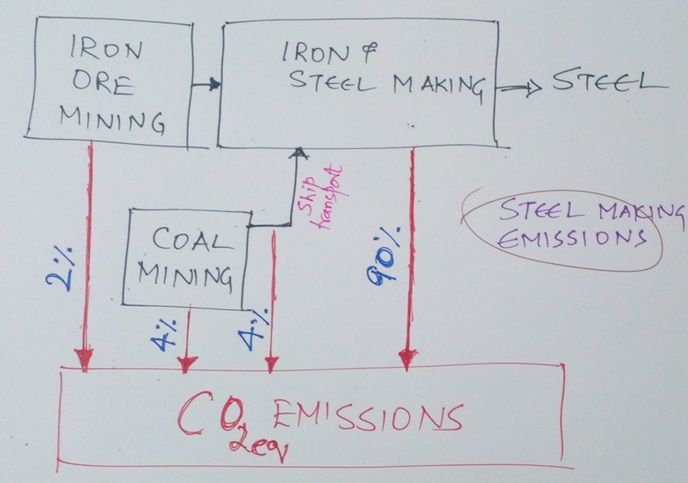
To get a better idea of what I'm talking about, do look at my scribbled illustration at the end. You will see that, for a typical large steel company, the CO2 footprint from long distance shipping (about 10000 Km) will form only about 4-5% of the total CO2 footprint of steel that comes out of a steel mill.
In this case, if biofuels had reduced emissions by about 20%, we are talking about a 1% reduction (20%*5%) in overall emissions from this exercise!
That is, biofuel in shipping is an important development - but more for the shipping sector and much less for the steel sector, though we are all happy with them for making a start!
For those interested in some math around emissions from shipping coal in this case (from Australia to India): Taking CO2 emissions metrics for ships (16 g/ ton Km), and using the total distance from Gladstone in Oz to Paradip port (10,000 Km), we get the total emissions from shipping for 1 ton of coal to be about 0.16 ton of CO2. With a 20% emissions reduction from the blend (as mentioned in the news report), we get the emissions reduced by 0.04 ton of CO2 per ton of coal.
To give you some perspective, burning 1 ton of coal in a blast furnace alone will lead to about 1.8 tons of CO2, which is about 45 times as much as the emissions reduced in this exercise!
Other notes:
1. CO2 emissions mentioned in the illustration is CO2eq which includes all emissions (such as CH4).
2. All percentages are for typical integrated iron & steel companies working with blast furnaces, are approximate as emissions vary depending on many factors.
3. Steel makers are also pursuing other avenues to reduce emissions from blast furnaces.
(See all my decarbonization posts from 𝐍𝐞𝐭 𝐙𝐞𝐫𝐨 𝐛𝐲 𝐍𝐚𝐫𝐬𝐢 - https://shorturl.at/jx137 )