
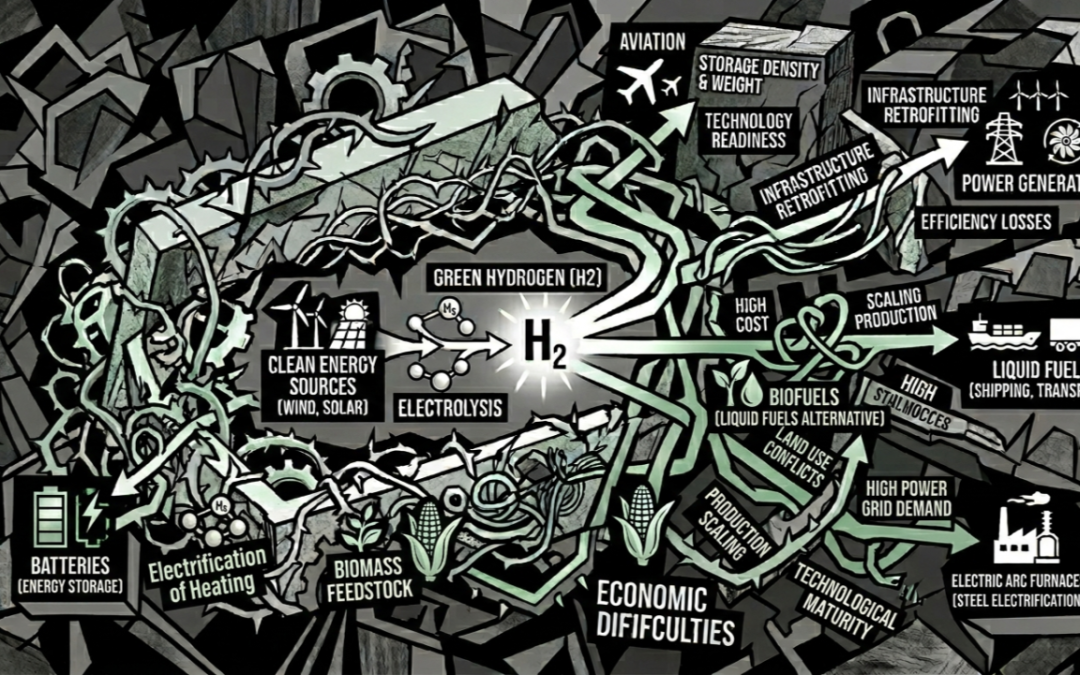
Green hydrogen might be a big part of a low-carbon future, but that future is much further away than many thought.
Why is that so?
More than the cost of green hydrogen, it might have to do with the characteristics of the end-use sectors.
Read on...
I first started studying green hydrogen right in the middle of COVID, so we are talking about 2020. The industry was still in its early stages, and many things were hazy.
Starting in 2021, the news around green hydrogen started heating up. By the end of 2022, EAI had undertaken a couple of brief green hydrogen market studies and, by the end of 2024, a few more—this time, much more detailed studies.
All these studies, which got our team up close and personal with many stakeholders in the green hydrogen sector, also gave me the unique opportunity to understand the real potential of this amazing molecule, as well as distinguish business hype from reality.
Fast forward two years, and the key lessons I learned from those studies are now being played out on the ground.
If you ask any good investment banker who has been covering the sector, they will tell you that the sector is in the harsh reality-check phase.
For once in my life, I fully agree with an investment banker.
While there is still a good amount of PR from corporates and governments worldwide about the next big green hydrogen investment they plan to make, actual capital deployment in the sector has seen a significant decline. While precise estimates are hard to come by on annual capital deployment for green hydrogen projects worldwide, our analyses suggest these could have decreased by up to 50% between 2023 and 2025, and this lukewarm trend could continue for some time.
Where did the sector go wrong in its growth assumptions?
In my opinion:
They did not use the wide lens framework for assessing market demand and consumption of a new product.
The wide lens framework views the entire ecosystem that a new product belongs to before arriving at an inference on the product's market viability.
Many analysts focused on just one aspect of green hydrogen: its cost.
Especially compared to grey hydrogen.
But I have seen very few deep analyses on the end-use sectors that will actually consume green hydrogen.
For most analysts, the thinking was:
If green hydrogen prices come down to $1/kg, then green hydrogen will soon replace grey hydrogen, natural gas, petrol, diesel, batteries, coal-powered electricity, coke-powered blast furnaces, and fossil-based plastics across the world.
Sure, these analysts were not naive enough to believe this would happen overnight. But many of the adoption timelines I saw were far too optimistic.
Consider this.
Worldwide, about 100 million tonnes of conventional (grey) hydrogen are already being produced and consumed, mainly for fertilizers, petroleum refining, and hydrogenation. These are relatively straightforward drop-in replacement sectors that can adopt green hydrogen once it reaches price parity—a global market worth roughly $100–150 billion.
Even reaching that parity could take much longer than originally predicted. Many expected it by 2030, but based on the trends I see today, that appears increasingly unlikely.
The real opportunity for green hydrogen, however, lies beyond today's hydrogen markets.
It could potentially be used for:
-
Transportation fuels (global oil demand for transport is about 3.25 billion tonnes per year)
-
Plastics manufacturing (about 450 million tonnes annually)
-
Large-scale energy storage alongside batteries
-
Steelmaking, replacing coke in blast furnaces (roughly 500 million tonnes of coke used annually)
-
And many more industrial applications
You get the idea.
This was the dream that many green hydrogen companies sold to investors—a dream that implied a market approaching one trillion dollars.
In theory, all of this is possible.
In practice, however, many of these industries will require years—and in some cases decades—to transition to green hydrogen, even if hydrogen costs fall to $1/kg.
Take aviation, for example.
I have read numerous glowing reports claiming that green hydrogen will soon power commercial airplanes.
Most of these articles were written by journalists who had done very little technical research. Surprisingly, some finance professionals also bought into the story without conducting much independent analysis.
Hydrogen-powered commercial aircraft?
Not anytime soon—unless you're talking about a tiny two-seater flying 100 miles.
While battery-electric aircraft currently face severe energy density limitations, hydrogen is not a silver bullet either.
Today, there are roughly 30,000 large commercial aircraft operating worldwide.
At an average value of $100 million each, that represents about $3 trillion worth of aircraft.
These are long-lived assets.
Their average age is around 15 years, and commercial aircraft commonly remain in service for 25 to 30 years.
None of these aircraft can operate on anything other than aviation fuel (or drop-in replacements such as Sustainable Aviation Fuel).
Ignore the optimistic press releases.
Neither Boeing nor Airbus is seriously developing hydrogen-powered large commercial aircraft for near-term deployment. Internally, both companies appear to view hydrogen as a long-term opportunity—but neither has clearly defined what "long term" actually means.
Considering that a new commercial aircraft typically takes 10–15 years from design to commercialization, the conclusion becomes fairly obvious.
Do not expect large-scale adoption of hydrogen-powered commercial aircraft within the next 50 years.
What about hydrogen-derived liquid fuels such as methanol?
I remain skeptical.
These fuels are not drop-in replacements for aviation fuel, meaning they require either major aircraft modifications or entirely new aircraft platforms.
Hydrogen passenger cars?
This prediction did not come from journalists.
Companies like Toyota strongly promoted hydrogen fuel-cell passenger vehicles.
But it has always been difficult to understand how fuel-cell passenger cars could outperform battery-electric vehicles.
Consider the physics.
-
Battery-electric vehicles achieve approximately 80% round-trip efficiency.
-
Hydrogen fuel-cell vehicles achieve less than 40%.
This means battery-electric vehicles can travel roughly twice as far using the same amount of renewable electricity.
Why would anyone focused on the efficient use of clean energy choose hydrogen for passenger cars?
Unless batteries are fundamentally unsuitable—which they clearly are not.
Heavy transport may be different.
Hydrogen's prospects in heavy trucks, shipping, and certain industrial applications are certainly more promising.
However, I remain doubtful that any of these sectors will experience widespread commercial adoption before 2040.
Steelmaking may be one of the few exceptions because of the enormous pressure to decarbonize and the limited alternatives available.
So where does that leave green hydrogen?
For at least the next decade or two, investors should be comfortable with green hydrogen primarily serving as a drop-in replacement for grey hydrogen.
Beyond that, only selected sectors are likely to develop compelling business cases.
This is because competing technologies are also advancing rapidly:
-
Batteries
-
Biofuels
-
Bio-based feedstocks
-
Electric furnaces
-
Other electrification technologies
Electrolyser improvements and economies of scale may eventually bring green hydrogen close to $1/kg.
But even if that milestone is achieved, I do not expect many of the highly publicized end-use applications to take off as quickly as many forecasts suggest.
Perhaps more analysts would have reached similar conclusions had they adopted a wider lens while evaluating the green hydrogen opportunity.
One framework that deserves special mention is the Hydrogen Ladder, developed by Liebreich Associates.
It remains one of the most practical ways to think about where hydrogen truly makes sense—and where it does not.
Thank you, Michael Liebreich, for creating such a valuable framework.