
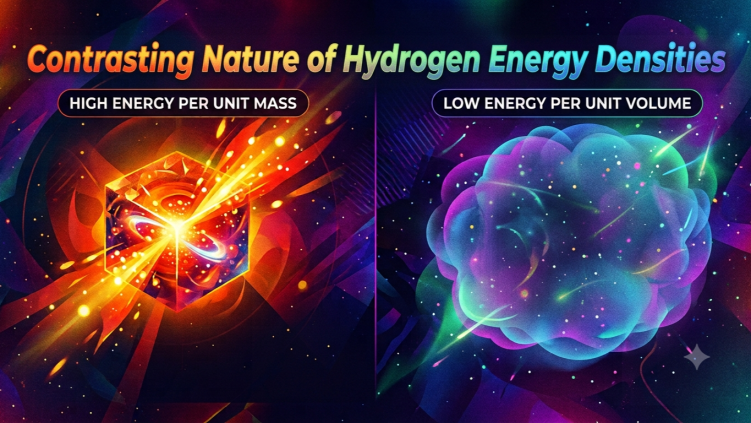
During my first ten years of work in climate tech, revolving mostly around solar, biomass and biofuels, most discussions were about energy efficiency, yield, costs…energy density was hardly a debate topic.
Since the growth of EVs and green hydrogen, both starting in the 2017-20 period, energy density has taken centre stage.
To make people from outside the energy domain relate to energy density better, I often tell them to imagine three "buckets".
The first bucket contains 1 Kg of Li-ion batteries, the second a Kg of petrol, and the third, a Kg of hydrogen.
I then ask them the following: If Bucket 1 (batteries) contains 1 unit of energy, how much would bucket 2 (petrol) and bucket 3 (hydrogen) contain?
Most of them come up with numbers ranging from 2-5...The correct answer? About 50 and 130!
Yes. Petrol (gasoline) has about 50 times the energy density and hydrogen, an astronomical 130 times the energy density as Li-ion batteries.
Li-ion batteries have energy densities of about 250 Wh/Kg; gasoline: about 13000 Wh/Kg and Hydrogen, 33,000 Wh/Kg.
I call these the 50:1 and 130:1 challenges for batteries. Battery, for all its wonderful virtues, has the Achilles Heel in its energy density.
Hydrogen has by far the highest energy density among all solid, gaseous and liquid fuels (including fossil ones; but excluding nuclear fuels such as uranium, which are mega gargantuan beasts in energy density. The energy density of pure U-235 is 24,000,000 kWh/Kg, or 24,000,000,000 Wh/Kg = 7,00,000 times that of hydrogen, 1.8 million times that of petrol/diesel and almost 100 million times that of a Li-ion battery - go figure!).
On energy density, hydrogen beats its nearest non-nuclear competitor by an incremental factor of 2.5 (250%).
Stunning!
What I've discussed above is gravimetric energy density (energy/per unit mass). Also relevant is Volumetric energy density (energy/volume).
And here comes the twist in the tale you have been waiting for.
Take three buckets, and this time, fill each with a 𝐥𝐢𝐭𝐞𝐫 of the following: Battery material, Petrol & Hydrogen, 𝘢𝘭𝘭 𝘪𝘯 𝘵𝘩𝘦𝘪𝘳 𝘯𝘢𝘵𝘶𝘳𝘢𝘭 𝘴𝘵𝘢𝘵𝘦𝘴, at STP.
If the battery bucket has 1 unit of energy, how many units of energy would the petrol & hydrogen buckets have?
My audience, a bit chastened and duly enlightened by now, gives confident numbers in the 50-100 range for both.
The correct answer? 20 for petrol and 0.006 for hydrogen.
Measured on energy volume-wise, petrol still does much better than batteries, but hullo, what happened to our star, Hydrogen?
It has dissipated. From an imperial gravimetric density superiority over batteries of 130:1, it has plunged to a deplorable depth of 0.006:1 on volume (a 22,000 fold drop).

This, ladies and gentlemen, is the strange, riveting tale of hydrogen energy density.
A tale that will have enormous implications on how, where and for what hydrogen is used.