
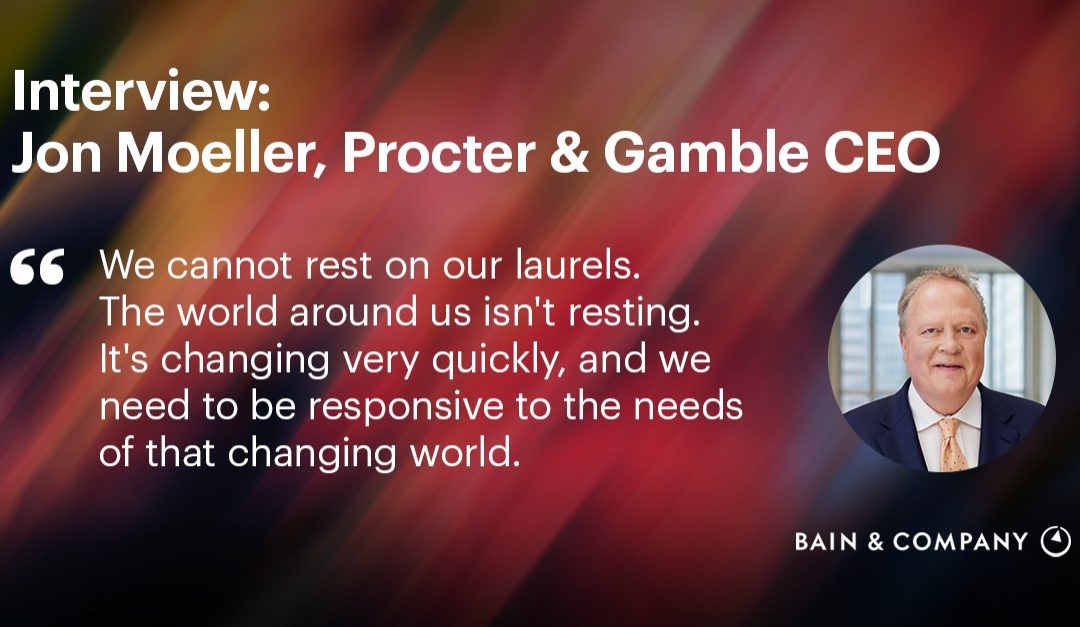
𝐄𝐒𝐆 𝐢𝐬 𝐧𝐨𝐭 𝐚 𝐭𝐚𝐱, 𝐢𝐭'𝐬 𝐚𝐧 𝐨𝐩𝐩𝐨𝐫𝐭𝐮𝐧𝐢𝐭𝐲 𝐭𝐨 𝐭𝐡𝐫𝐢𝐯𝐞 - 𝐉𝐨𝐧 𝐌𝐨𝐞𝐥𝐥𝐞𝐫, 𝐂𝐄𝐎 𝐏𝐫𝐨𝐜𝐭𝐞𝐫 & 𝐆𝐚𝐦𝐛𝐥𝐞
𝘊𝘌𝘖 𝘊𝘭𝘪𝘮𝘢𝘵𝘦 𝘐𝘯𝘴𝘪𝘨𝘩𝘵𝘴 𝘧𝘳𝘰𝘮 𝘊𝘭𝘪𝘥𝘦𝘮𝘺
As part of the CEO Climate Insights section, we review interviews given by CEOs, and present curated inputs that throw light on unique and valuable perspectives from these top honchos.
Here's one on ESG from the CEO of Procter & Gamble, Jon Moeller, from an interview with Bain & Co.
Regardless of your views on ESG, I think you will find 𝘩𝘪𝘴 𝘵𝘢𝘬𝘦 𝘰𝘯 𝘌𝘚𝘎 interesting:
"ESG is not an organizational tax. It’s an opportunity to thrive. ESG had to be integral to everything. For example, if our strategy is based on sustainable superiority, we must attract superior talent, meaning we must have a superior employee value proposition. When I got into this role, I wanted ESG owned by the business units, not just owned by the corporation. A couple of resources in corporate weren’t going to make the change that needed to be made." ( https://lnkd.in/gTbfXZAs )
The above can be said about any framework for corporate climate action. If climate action is driven by a small team without engagement from the rest of the firm, or if it is done in silos without collaboration between divisions, it will most likely end up as yet another business activity with vested targets and narrow focus.
But climate action cannot be business as usual - because it was business as usual that has landed up in this nice, big mess.
While what Moeller has articulated is indeed a perspective that strikes a chord with me, how can this really be implemented in massive firms such as P&G? I am trying to visualize a typical sales director from large firms trying to think of environmental impacts for a big part of his or her job, and I utterly fail at such visualization. Most corporate workers are far too removed from any environmental considerations, from what I have witnessed in my last 15 years of work in this field.
So what can be done to make tens of thousands of employees in large firms climate conscious, and guide them on impactful measures they can apply in their professions? At CliDemy - the Climate Academy, we have been researching this theme, and our preliminary inference is that there has to be a two-pronged approach:
1. For the short term, arrive at simple, tangible low carbon actions aligned to the decarbonization roadmap many of the companies already have - an example could be to provide training to truck drivers on energy efficient driving.
2. For the medium and long term, the "education" has to be more fundamental to make every employee feel that ESG or low carbon or decarbonization is not a "tax" but is an opportunity for each while being a benefit for the planet.