
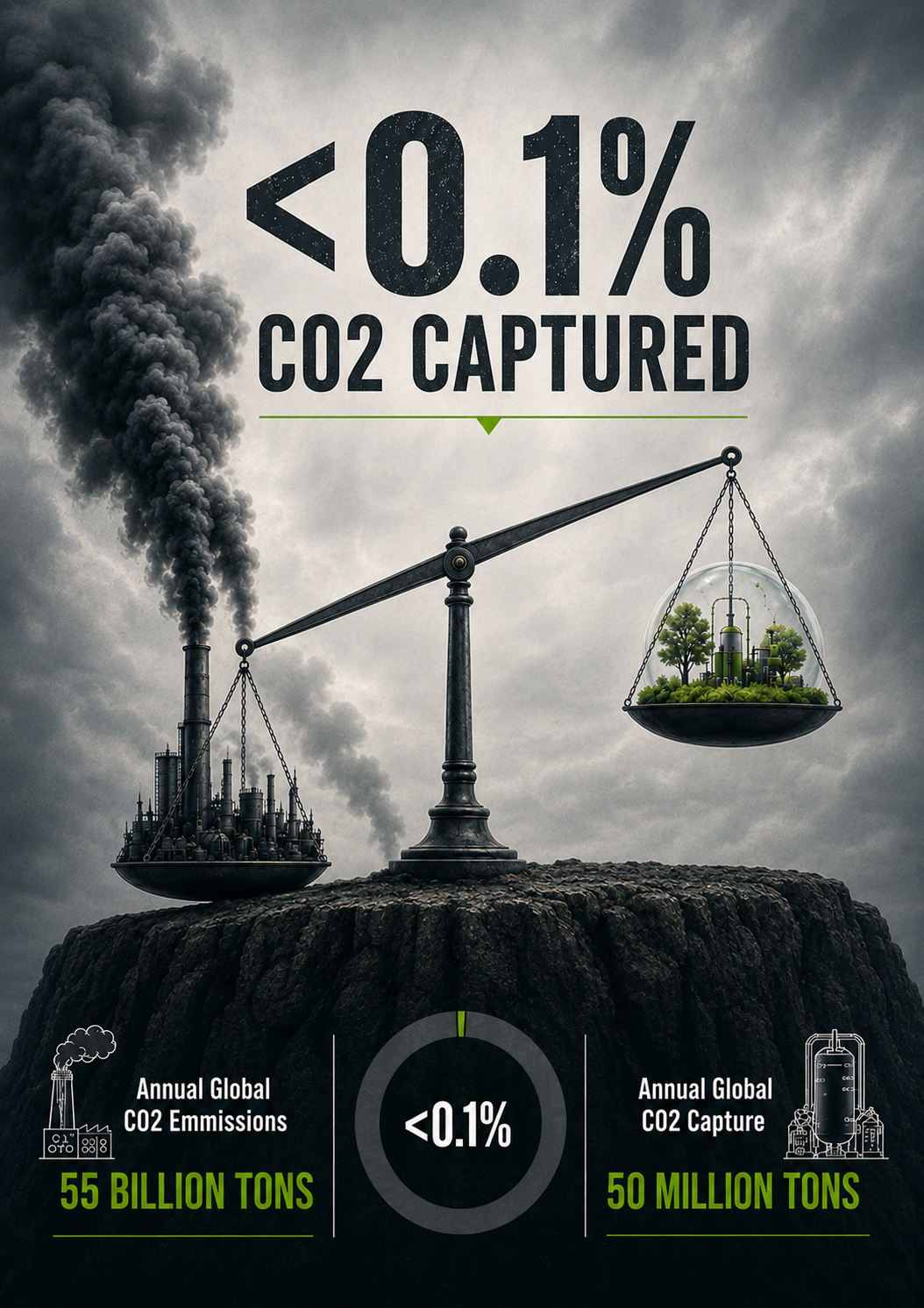
What: We Are Capturing a Tiny Fraction of What We Emit
Global energy-related CO₂ emissions reached nearly 38.4 billion tonnes in 2025. At the same time, operational carbon capture capacity was only around 64 million tonnes per year in July 2025. That means the amount of CO₂ that can currently be captured is tiny compared with the amount being emitted every year.
Three things stand out:
- The scale mismatch is enormous. We are talking about tens of billions of tonnes of annual emissions versus tens of millions of tonnes of operational capture capacity. The gap is measured in orders of magnitude, not percentages.
- Carbon capture is not a substitute for avoiding emissions. We should first reduce emissions through efficiency, electrification, renewables and process changes. Capture becomes particularly valuable for emissions that are difficult or expensive to eliminate completely.
- The technology itself is no longer the main question. Around 77 commercial CCS facilities were operating globally in July 2025, with operational capture capacity rising to about 64 Mtpa. The bigger question is how quickly we can replicate, finance and connect these projects at industrial scale.
Why: Because Some Carbon Will Be Very Difficult to Avoid
Why should we care about scaling carbon capture if reducing emissions is the priority?
Because even in a highly decarbonised economy, some sectors will continue to have emissions that are technically difficult to eliminate.
- Hard-to-abate industries need additional tools. Cement, steel, chemicals, refining and some other industrial processes have process emissions or high-temperature energy requirements that cannot always be eliminated simply by switching to renewable electricity. The IEA identifies these sectors as important applications for CCUS in the net-zero transition.
- There is a large economic opportunity alongside the climate challenge. Carbon capture creates demand for solvents, membranes, compressors, heat integration, CO₂ pipelines, geological storage, monitoring, software and project development. The Global CCS Institute estimates that the global CCS project pipeline had reached 513 Mtpa of capture capacity in 2025, although much of that capacity is still under development rather than operating.
- But capture has real challenges. Capture consumes energy, adds capital and operating costs, and requires transport, storage and credible measurement of the CO₂. The IEA's 2026 assessment highlights delays in permitting and construction, as well as the need for stronger business models and risk-sharing mechanisms.
How: Make Carbon Capture an Industrial Deployment Problem, Not Just a Technology Problem
- Start where capture makes the most sense. Prioritise large, concentrated CO₂ sources such as cement, steel, chemicals, fertiliser, ethanol and natural-gas processing rather than trying to capture dilute CO₂ everywhere. High-concentration streams can offer better economics and a clearer path to scale. The IEA notes that more than 60% of operational capture capacity has historically been concentrated in natural-gas processing, precisely because it is among the lower-cost capture applications.
- Build carbon-management clusters, not isolated projects. A factory installing a capture unit is only step one. We need shared CO₂ pipelines, aggregation hubs, storage sites, monitoring systems and common infrastructure so that several emitters can use the same transport and storage network. This is already emerging as an important direction for CCUS deployment.
- Make projects investable and measurable. Companies should establish a baseline CO₂ inventory, identify their highest-value capture streams, conduct a techno-economic assessment, secure a transport/storage pathway, and put in place a measurable CO₂ offtake or storage contract before committing major capital. Governments can accelerate this by reducing permitting risk, supporting shared infrastructure and using mechanisms such as contracts-for-difference or other risk-sharing models. Recent IEA analysis shows that more than US$15 billion of commercial debt has flowed into CCUS projects over the past two years, predominantly where governments have reduced project risk.
The Takeaway
The point of the “<0.1% CO₂ Captured” visual is not that carbon capture is failing.
It is that carbon capture has barely begun to operate at the scale required by the problem.
We have moved from asking “Can we capture CO₂?” to a much more useful question:
“Where can we capture it economically, how do we transport and store it, and how quickly can we replicate that model?”
That shift from technology demonstration to industrial deployment is where the real carbon-capture opportunity lies.
And perhaps the most important caveat is this: we should not use carbon capture as an excuse to keep emitting. The priority remains avoiding emissions wherever possible. Capture should tackle the residual emissions that are genuinely difficult to eliminate and do so with technology, economics and measurement that stand up to scrutiny.